CSFA Home
Who Were the First Americans?
About CSFA
Education at CSFA
CSFA Research
Publications and Archives
Join CSFA
Support CSFA
CSFA Image Gallery
Resources on the Web
Contact CSFA
© 2002 - 2009
Center for the Study of the First Americans
All Rights Reserved.

Publications and Archives

Publications & Archives


The Center for the Study of the First Americans has an active program of publications that are of interest to both the professional archaeologist and public.

Mammoth Trumpet logo

The Mammoth Trumpet

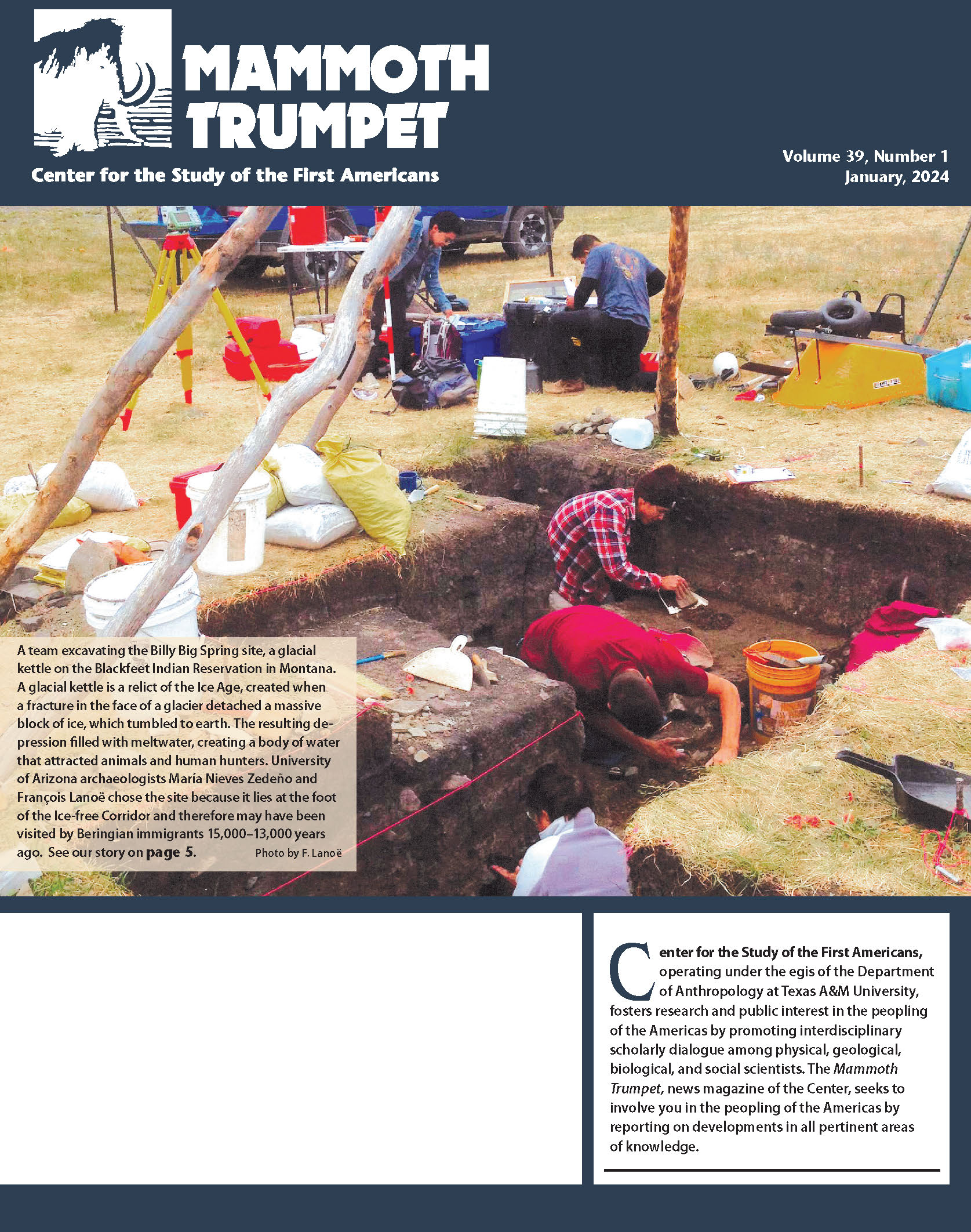
The Mammoth Trumpet provides interesting articles about the First Americans.  Articles include breaking news on important discoveries and issues facing First Americans research.  This publication is designed for both the general public and scholarly community.  The Mammoth Trumpet is published 4 times a year.

Mammoth Trumpet Archives

How to Receive the Mammoth Trumpet
A subscription to the Mammoth Trumpet is included when you become a member of the Center for the Study of the First Americans.  (link to membership)


Current Research in the Pleistocene logo

Current Research in the Pleistocene

This is a scholarly journal that has been published by the Center since 1984.  It provides syntheses on significant topics in the field, updates on ongoing site excavations, and the results of important research.  Short peer-reviewed articles keep you up to date.  Current Research in the Pleistocene is published once a year.


Annual deadlines for submission of manuscripts to CRP is February 15th.
Download the current Call for Papers.

Current Research in the Pleistocene Archives

How to Receive Current Research in the Pleistocene
Copies of Current Research in the Pleistocene can be purchased from the Center for the Study of the First Americans.  (Links to order forms: current and previous issues)

  There are three ways to purchase CRP:

1) To join now, follow the link below and use your credit card
Order membership via credit card


2) Call the Center if you have any problems or need assistance in placing your order online at 979-845-4046.

3) Print and fill out the following order form: (CRP ORDER FORM).

  • Enclose a check or money order made payable to Center for the Study of the First Americans or include your credit card information. 

  • Mail the order form and check to:

Membership
Center for the Study of the First Americans
Department of Anthropology
Texas A&M University
4352 TAMU
College Station, TX 77843-4352

If you have any questions, please call us at 979-845-4046 or email us at csfa@tamu.edu.


Book Series


The Center book series includes site reports and syntheses of important topics in First American studies.  These books can be purchased from the Texas A&M University Press.

Paleoamerican Origins - Cover Jacket

Paleoamerican Origins: Beyond Clovis
Edited by Robson Bonnichsen, Bradley T. Lepper, Dennis Stanford, & Michael R. Waters


Paleoamerican Origins is an outgrowth of the Clovis and Beyond Conference held in Santa Fe, New Mexico, in 1999. This book presents 23 up-to-date syntheses of important topics surrounding the debate over the initial prehistoric colonization of the Americas. These papers are written by some of the foremost authorities who are on the trail of the first Americans. The papers in this volume include a discussion of the archaeological evidence for Clovis and Pre-Clovis sites in North America (11 papers) and South America (2 papers). In addition, papers on the genetic evidence (2 papers) and skeletal evidence (4 papers) provide insights into the origins of the first Americans. Additional papers include ideas on the changing perceptions of Paleoamerican prehistory, public policy and science, and a comprehensive concluding synthesis.

9x11, 364 pages

>> Order this book from Texas A&M University Press >>


Ice Age Peoples of North America - Cover Jacket

Ice Age Peoples of North America:
Environments, Origins, and Adaptations of the First Americans
Edited by Robson Bonnichsen & Karen L. Turnmire

This volume provides an up-to-date summary of important new discoveries from Northeast Asia and North America that are changing perceptions about the origin of the First Americans. Even though the peopling of the Americas has been the focus of scientific investigations for more than half a century, there is still no definitive evidence that will allow specialists to say when the First Americans initially arrived or who they were.

The nineteen papers collected here provide regional archaeological syntheses and address such topics as ice marginal dynamics, the impact of plant nutrients in glacial margins, and periglacial ecology of large mammals. The concluding chapter discusses conceptual frameworks used to explain the peopling of the Americas.

This volume provides an up-to-date summary of important new discoveries earlier than ten thousand years old from Northeast Asia and North America that are changing our perceptions about the origin of the First Americans. It offers a detailed compendium of late-Pleistocene Paleoamerican archaeological records that can serve as a foundation of existing knowledge in this field and for creating the next generation of models that seek to explain the peopling of the Americas.

9x11, 536 pages

>> Order this book from Texas A&M University Press >>


New Perspectives on the First Americans - Cover Jacket

New Perspectives on the First Americans
Edited by Bradley T. Lepper & Robson Bonnichsen

The field of first American studies is undergoing significant changes. The traditional model that the Americas were only peopled once by Clovis big-game hunters from Siberia at the end of the last Ice Age has seriously been challenged. Most now believe that the Americas were peopled more than once.

Against this backdrop of controversy, the CSFA and its partners convened the Clovis and Beyond Conference in Santa Fe, New Mexico, in 1999, and brought many of the major players of the field to the conference forum who have a stake in the future of America's past.

New Perspectives on the First Americans contains short and concise papers from this conference that focus on the following themes: pre-Clovis archaeology, Clovis-era archaeology, Paleoamerican paleobiology, new approaches to the study of Paleoamericans, Paleoamericans and public policy, and new directions for Paleoamerican archaeology.

Collectively, these papers represent the intellectual ferment in a field seeking to reconcile itself with changing scientific developments in an evolving social/political context.

6x9, 240 pages

>> Order this book from Texas A&M University Press >>


Where the South Winds Blow - Cover Jacket

Where the South Winds Blow:
Ancient Evidence for Paleo South Americans
Edited by Laura Miotti, Monica Salemme, Nora Flegenheimer; Editor in Chief: Robson Bonnichsen

The early prehistory of South America is poorly known by the English speaking world. This edited volume, translated from Spanish, contains twenty-one short papers documenting some of the most important recently investigated early archaeological sites from South America.

These papers report Paleoamerican complexes and excavations of sites older than eleven thousand radiocarbon years before present, as well as cover issues in geoarchaeology, geochronology, Pleistocene extinction, and paleoecology. Numerous graphics are used to illustrate site locations, excavations, and artifacts.

6x8, 240 pages

>> Order this book from Texas A&M University Press >>


Who Were the First Americans - Cover Jacket

Who Were the First Americans
Edited by Robson Bonnichsen

Proceedings of the 58th Annual Biology Colloquium, Oregon State University. Seven chapters include genetic and craniometric studies and what they mean in regard to the initial peopling of the Americas.

>> Order this book from Texas A&M University Press >>


Bone Modification - Cover Jacket

Bone Modification
Edited by Robson Bonnichsen & Marcella H. Slog

Thirty chapters provide a comprehensive discussion of the human modification of animal bones through breaking, polishing, and flaking to produce expedient and formal tools. Authorities from around the world provide insights into bone taphonomy and how to interpret modified bones from archaeological contexts. Bone tools and other modified bones from sites in North America, Asia, Africa, and Europe are discussed and cover the range from early hominids to Clovis. Other chapters include discussions of experimental replication of bone breakage patterns and tool manufacture, ethnographic examples of the modification of bone, bone use-wear studies, and the interpreting and documenting of modified bone from archaeological sites.

9x11, 534 pages

>> Order this book from Texas A&M University Press >>


Method and Theory for Investigating the Peopling of the Americas - Cover Jacket

Method and Theory for Investigating the Peopling of the Americas
Edited by Robson Bonnichsen & D. Gentry Steele

Sixteen chapters provide an overview of important topics in First Americans research. Leading authorities in the field discuss the history of archaeological investigations into the peopling of the Americas, AMS radiocarbon dating, geoarchaeology of Paleoindian sites, blood residue analysis on stone tools, and an evaluation of the Pacific coast migration route from Asia to North America. Several chapters provide valuable information on the biological and linguistic evidence for the first pioneers to the Americas.

9x11, 264 pages

>> Order this book from Texas A&M University Press >>


Projectile Point Technology and Economy - Cover Jacket

Projectile Point Technology and Economy
A Case Study from Paiján, North Coastal Peru: Pampa de Los Fosiles 14, Unit 1
Edited by Claude Chauchat & Jacques Pelegrin

The Paijan complex, of late Pleistocene to early Holocene age, is known from numerous open-air sites and one rock shelter and occurs more than one thousand kilometers off the Peruvian coastal desert. Claude Chauchat and his team present a detailed archaeological case study of the Cupisnique region at the Pampa de Los Fosilies locality on the north coast of Peru. This volume exemplifies the use of the Chaine operationaire approach, which views lithic assemblages as a succession of technical actions beginning at the moment of raw material acquisition, manufacture, utilization, and finally abandonment of tools.

This case study documents raw material use at flaking loci, description of cores, flakes, flake tools, limaces, bifaces, and lithic reduction practices of the Paijan site occupants. In addition to providing a detailed history of stone tool flaking activities, raw material acquisition patterns combined with regional survey data provide the foundation for inferring mobility models for the Paijan people.

8 1/2x11, 120 pages

>> Order this book from Texas A&M University Press >>


Brazilian Studies - Cover Jacket

Brazilian Studies
The Sambaqui at Forte Marechal Luz, State of Santa Catarina, Brazil: Archaological Research at Six Cave or Rockshelter Sites
By Alan L. Bryan

Brazilian Studies includes an analysis of the Sambaqui at Forte Marechal Luz in Santa Catarina on Brazil's south coast, plus archaeological research at six cave or rockshelter sites in interior Bahia.

9x11, 168 pages

>> Order this book from Texas A&M University Press >>


Taima-Taima - Cover Jacket

Taima-Taima
A Late Pleistocene Paleo-Indian Kill Site in Northernmost South America
- Final Reports of 1976 Excavations -
Edited by Claudio Ochsenius & Ruth Gruhn

A reprint from the South American Quaternary Documentation Program reporting on a northern Venezuela Paleoindian kill site, this volume includes examinations of environment, excavations, stratigraphy, dating, artifacts, faunal analysis, mastodon procurement, and the Taima-Taima site in context.

6x9, 138 pages

>> Order this book from Texas A&M University Press >>